

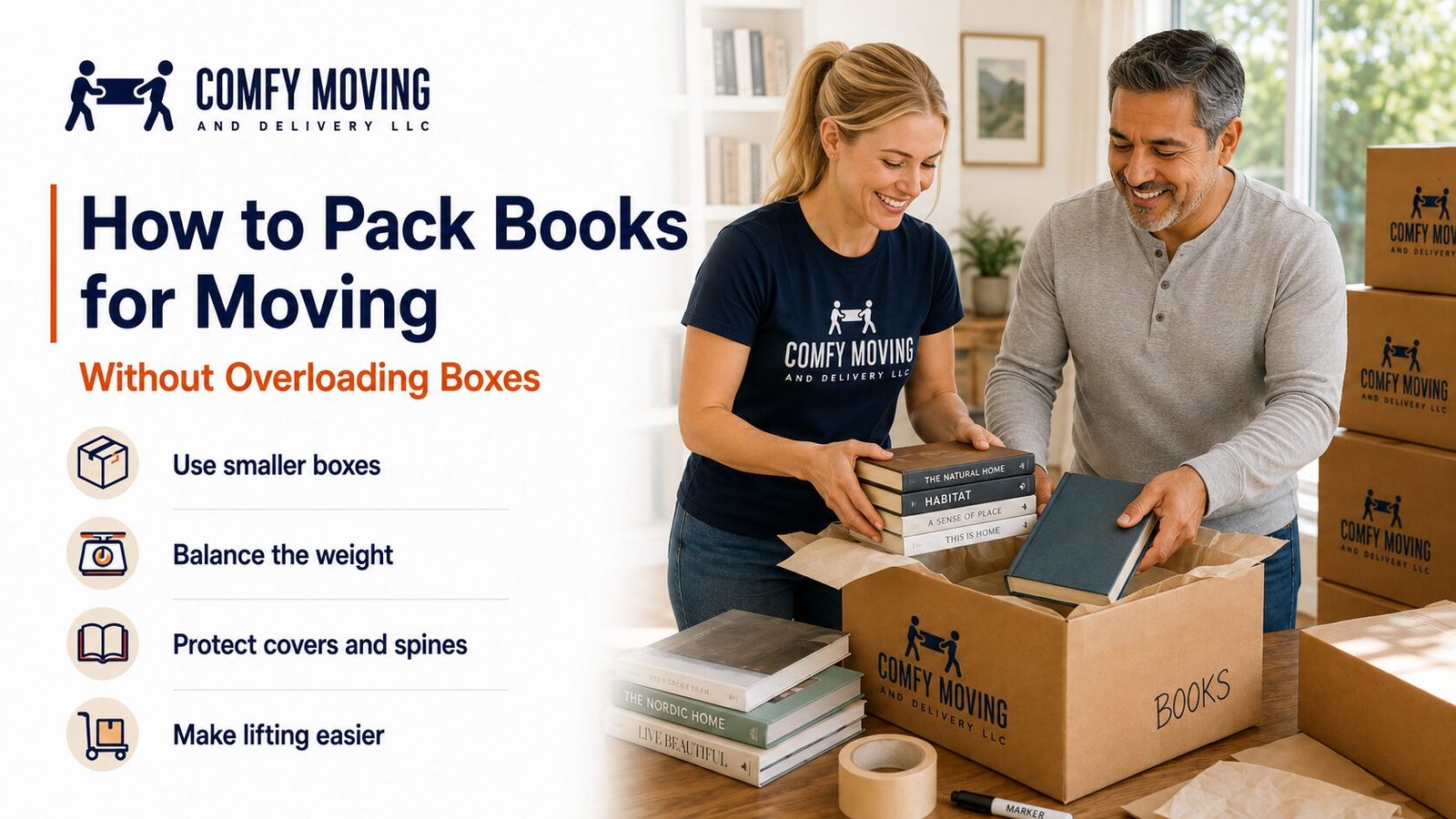
How to Pack Books for Moving Without Overloading Boxes
A single book is easy to carry. A shelf full of them is another story.
Books are compact, which makes it tempting to fill every box to the top. The problem becomes obvious when someone tries to lift that box. What looked like an efficient use of space can turn into a torn carton, a strained back, or a pile of books sliding across the moving truck.
Learning how to pack books for moving is mostly about controlling weight. The books need enough support to keep their covers, pages, and spines in good condition, but each box also needs to remain safe and practical to carry.
The goal is not to fit the largest number of books into each carton. The goal is to create smaller, stable boxes that can be lifted, stacked, transported, and unpacked without trouble.
Sort Your Books Before You Buy Boxes
Packing becomes much easier when you know what is actually making the move.
Take the books off one shelf at a time and divide them into a few simple groups:
- Books you read or use regularly
- Books you want to keep but rarely open
- Valuable, signed, antique, or sentimental books
- Oversized books and albums
- Books that can be donated, sold, or recycled
Moving is a useful time to remove duplicates, old textbooks, outdated manuals, and books you no longer want. There is little benefit in paying to pack and transport items that will go straight into a donation box after the move.
Keep donated books separate from the moving boxes. Label them immediately so they are not accidentally loaded onto the truck.
Once you know which books are coming with you, group them by approximate size and weight. Similar books fit together more securely and leave fewer awkward gaps inside the box.
Use Small Boxes for Most Books
Large moving boxes look efficient, but they are a poor match for dense items. Books can make a large carton dangerously heavy long before it looks full.
Small moving boxes are usually the better choice because they:
- Keep the total weight manageable
- Are easier to carry through doorways
- Put less pressure on the cardboard
- Stack more securely in the truck
- Reduce the chance of overloading
- Make unpacking easier to control
Use clean, dry, corrugated cardboard boxes with firm walls and intact flaps. Avoid cartons that feel soft, have water stains, or have already been crushed at the corners.
Previously used boxes may be suitable if they are still strong. Check the bottom carefully before packing. A box can look fine from the outside while the seams underneath are already weakened.
How Heavy Should a Box of Books Be?
There is no benefit in proving that you can fit an entire bookcase into three cartons.
A packed book box should be comfortably liftable without dragging, tilting, or holding it against your body for support. The right weight depends on the box, the person carrying it, the route to the truck, and whether stairs are involved.
As a practical rule, stop adding books while the carton still feels manageable. Test the weight before sealing it.
Lift the box a few inches from the floor using proper form. If it already feels uncomfortable, remove several books and replace the empty space with lightweight items or packing paper.
Do not assume professional movers want the heaviest possible boxes. Reasonably weighted cartons are safer to handle and easier to position securely inside the truck.
Supplies for Packing Books
You do not need a complicated packing setup, but the basic materials should be ready before you start.
Gather:
- Small corrugated moving boxes
- A few medium boxes for oversized books
- Strong packing tape
- A tape gun
- Packing paper
- Bubble wrap for delicate books
- Acid-free paper for collectible editions
- Permanent markers
- Labels or color-coded stickers
- Resealable bags for bookmarks or small accessories
- Scissors or a box cutter
Avoid using newspaper directly against books. Ink can transfer onto covers or page edges, especially if the books remain packed for an extended period.
Clothing and towels can fill space in ordinary book boxes, but they should not touch fragile, collectible, or light-colored covers unless the books have been wrapped first.
Reinforce Every Box Before Filling It
Books place a lot of pressure on the bottom seam, so a quick fold-and-go approach is not enough.
Close the lower flaps and run strong packing tape across the center seam. Extend the tape several inches up both sides of the box. Add a second strip across the bottom for additional support.
For heavier books, apply another strip in the opposite direction to form a cross. This helps distribute pressure across more of the cardboard.
Check that the bottom sits flat before adding anything. A bulging or uneven base will make the box harder to stack and more likely to tip.
Add a thin layer of crumpled packing paper to the bottom. It should create light cushioning without taking up too much room or making the books unstable.
How to Pack Books for Moving Step by Step
Once the books are sorted and the boxes are reinforced, work through one category at a time.
1. Start With Similar Sizes
Place books of similar height and depth together whenever possible. This creates straighter rows and prevents small paperbacks from being trapped beneath heavy hardcovers.
Do not force books into spaces that are too narrow. Pressure against the edges can bend covers and damage corners.
2. Pack Books Upright
For most standard books, place them upright as they would stand on a shelf.
Keep the spines facing the side of the box rather than pointing upward. A book resting on its spine can be damaged by the weight and vibration of the move.
Place books close enough together that they remain upright, but do not squeeze them tightly. You should be able to remove a book without pulling hard.
3. Pack Oversized Books Flat
Large art books, photo albums, atlases, and coffee table books may not fit safely in an upright row.
Place these books flat in short, even stacks. Put the largest and heaviest book at the bottom, followed by progressively smaller books.
Keep the stacks low. A tall pile places too much weight on the books underneath and can make the box difficult to balance.
Do not position books with their page edges facing downward while the spine points up. This can put unnecessary pressure on the binding.
4. Keep the Weight Balanced
Spread heavy books evenly across the bottom instead of loading them all on one side.
An unbalanced carton is harder to carry and more likely to tip when placed on a dolly or stacked in the truck.
Pause occasionally and lift the box slightly to check its weight. It is much easier to remove a few books before the carton is completely packed.
5. Fill the Gaps
Books should not slide around when the box is moved.
Use crumpled packing paper, bubble wrap, or clean soft items to fill open spaces along the sides. Add enough material to prevent movement without pressing tightly against the covers.
If a box reaches a safe weight before it is full, do not add more books simply to use the remaining space. Fill the top with lightweight items such as folded linens, pillows, or extra packing paper.
This keeps the carton stable while avoiding unnecessary weight.
6. Add a Protective Top Layer
Place packing paper across the top of the books before closing the flaps.
This layer helps prevent rubbing and keeps the books from shifting upward if the box is tilted. It also creates a barrier between the books and the taped top seam.
The upper flaps should close naturally. If you need to push them down, the box is too full.
How to Pack Valuable or Collectible Books
Signed books, antique volumes, family Bibles, first editions, rare publications, and delicate albums need more protection than everyday paperbacks.
Wash and dry your hands before handling them. Remove loose bookmarks, paper clips, photographs, pressed flowers, and other objects that may stain or crease the pages.
Wrap each valuable book individually in acid-free tissue or archival paper. Regular packing paper may be acceptable for a short local move, but acid-free materials are better when the books will remain boxed or stored.
After the paper layer, add light bubble wrap around the book. Secure the wrapping to itself rather than placing tape on the cover.
Pack valuable books in a separate, clearly labeled carton with firm padding on every side. Do not mix them with heavy textbooks or tightly packed hardcovers.
For irreplaceable books, consider keeping the box with you instead of loading it onto the moving truck. Avoid leaving valuable books in a hot car, damp garage, or uncontrolled storage space.
Packing Paperbacks Without Bent Covers
Paperbacks are light, but their covers and corners bend easily.
Arrange paperbacks in snug upright rows with books of a similar height. Fill small spaces with folded packing paper so the books do not lean.
Do not wedge a thick hardcover into a row of thin paperbacks. Its weight and rigid edges can crease the neighboring covers.
Mass-market paperbacks can also be packed flat in small stacks. Keep each stack even and avoid placing loose objects on top.
Packing Hardcover Books
Hardcovers hold their shape better than paperbacks, but they are heavier.
Place them upright in a small box with the spines against one side. Keep books of similar height together and use packing paper to support any uneven rows.
If the books are large or especially heavy, use a flat arrangement with only a few volumes per stack.
Watch the box weight closely. A small carton of hardcovers can become difficult to lift after only one or two rows.
Packing Children’s Books
Children’s books often include mixed shapes, thick board pages, pop-up sections, sound buttons, and delicate flaps.
Sort standard picture books by size and pack them upright. Place small board books together so they do not disappear between larger covers.
Wrap pop-up books and books with interactive pieces individually. Remove batteries from electronic books when practical, especially before long-term storage.
Keep favorite bedtime books in a separate essentials box. Having familiar stories available on the first evening can make the new space feel more settled.
Packing Photo Albums and Scrapbooks
Photo albums and scrapbooks can be heavier and more delicate than they appear.
Wrap each album in clean packing paper and add bubble wrap around fragile covers, clasps, or decorative elements. Place albums flat in short stacks.
Do not pack them upright if pages, photographs, or decorations could pull downward inside the binding.
Keep albums away from moisture and extreme temperatures. Family photographs and original documents are difficult or impossible to replace, so transporting them personally may be the safer option.
Seal and Label Each Box Clearly
Before sealing the box, check three things:
- The weight is manageable
- The books cannot shift
- The top closes without pressure
Run packing tape across the top seam and extend it down both sides. Add a second strip when the box contains heavy hardcovers.
Label at least two sides and the top. A clear label might read:
BOOKS – OFFICE – HEAVY
or:
CHILDREN’S BOOKS – BEDROOM – OPEN FIRST
Include the destination room so the box can be placed near the correct bookcase. Mark valuable or moisture-sensitive boxes separately, but avoid writing detailed descriptions such as “rare first editions” where everyone can see them.
Numbering the cartons can also help. For example:
- Library 1 of 6
- Library 2 of 6
- Library 3 of 6
A simple inventory list makes it easier to confirm that every box arrived.
How to Load Book Boxes Into the Moving Truck
Book boxes are dense, so they belong near the bottom of a stable stack.
Place them on a flat surface and keep them away from fragile cartons. Do not stack them on top of dishes, lamps, electronics, or boxes that may collapse.
Avoid building a very tall tower of book boxes. Even sturdy cartons can buckle when several heavy boxes are stacked vertically.
Keep the load balanced across the truck. Concentrating every book box in one small area creates excessive weight in that section and makes the stack harder to secure.
Boxes should not be placed where they can slide into furniture or tip during turns. Use straps and surrounding items to create a firm load without crushing the cartons.
Packing Books for Storage
Books going into storage need additional protection from moisture, dust, pests, and temperature changes.
Make sure every book is completely dry before packing. Do not use boxes that have been stored outside, in a basement, or in a damp garage.
For longer storage periods:
- Use new or very clean cartons
- Wrap valuable books in acid-free paper
- Avoid airtight plastic wrapping that may trap moisture
- Keep boxes off concrete floors
- Do not store them against exterior walls
- Choose a dry, temperature-controlled space when possible
- Avoid stacking excessive weight on top
Plastic bins may keep out surface moisture, but condensation can become a problem if books are packed in humid conditions. Make sure the books and container are dry before closing the lid.
Common Book Packing Mistakes
Using One Large Box for an Entire Shelf
The carton may look tidy, but it will be difficult to lift and more likely to tear. Divide the shelf across several small boxes.
Packing Books on Their Spines
The binding is not designed to support the book’s full weight during transportation. Pack books upright or flat instead.
Leaving Empty Space
Books that slide can develop bent corners, torn covers, and damaged page edges. Fill gaps with soft packing material.
Overstuffing the Box
Bulging sides and raised flaps are signs that the box is too full. Remove several books rather than forcing it closed.
Using Weak Tape
Light household tape may peel under the weight. Use strong packing tape designed for cardboard cartons.
Mixing Books With Fragile Items
Books can shift and crush glassware, frames, decor, and electronics. Keep dense items in their own boxes.
Forgetting About Moisture
A slightly damp book or box can create odor, staining, warped pages, and mold during storage. Pack only clean and dry materials.
When Packing Help Makes Sense
A few shelves may be easy to handle over a weekend. A home library, office archive, classroom collection, or last-minute move can involve hundreds of books and a surprising amount of weight.
Comfy Moving provides professional packing services for homes, apartments, offices, and selected rooms. We can bring durable boxes, pack books by size and weight, label cartons by destination, and prepare the load for safer transportation.
Packing support may be useful when:
- You have a large personal library
- The move includes stairs or long walking distances
- Books need to go into storage
- You are working with a short moving timeline
- The collection includes valuable editions
- Office files and reference books must stay organized
- You need help with both packing and unpacking
- Heavy lifting is not practical for your household
You can arrange help for the entire home or limit the service to books, fragile belongings, or other time-consuming areas.
Frequently Asked Questions
What Size Box Is Best for Moving Books?
Small corrugated moving boxes are usually the safest choice. They hold enough books to use space efficiently without becoming as heavy as a full medium or large carton.
Should Books Be Packed Flat or Upright?
Most standard books can be packed upright as they would sit on a shelf, with their spines facing the side of the box. Oversized books, albums, and large hardcovers may be packed flat in short, even stacks.
How Do You Keep Book Boxes From Getting Too Heavy?
Use small boxes, test the weight while packing, and stop adding books before the carton is full. Fill remaining space with packing paper, pillows, towels, or other lightweight materials.
Can Books Be Packed in Suitcases?
A rolling suitcase can work for a small number of heavy books because the wheels reduce carrying. Check the suitcase weight limit, protect the interior, and avoid filling it so heavily that it becomes difficult to lift into a vehicle.
Can I Use Plastic Bins for Books?
Yes, provided the books and bins are completely dry. Plastic can protect against surface moisture, but it may also trap humidity. Avoid sealing damp books inside plastic containers.
Do Books Need Bubble Wrap?
Most everyday books do not need individual bubble wrapping. Use packing paper and a firmly packed box. Bubble wrap is more useful for valuable books, decorative covers, albums, and delicate editions.
Can Movers Carry Boxes Full of Books?
Yes, but the boxes should remain reasonably weighted, securely taped, and clearly labeled. Several small book boxes are safer and easier to handle than one overloaded carton.
Pack for the Person Who Has to Lift the Box
The clearest answer to how to pack books for moving is simple: use smaller cartons, build stable rows, fill every gap, and stop before the box becomes a test of strength.
Books survive a move best when they cannot shift and the carton around them stays firm. The people carrying them also have a better day when every box can be lifted without strain.
A well-packed library may require more boxes, but that is not wasted space. It is a safer plan for the books, the movers, and your new home.
Need the shelves packed without spending several evenings lifting overloaded cartons? Comfy Moving can handle the boxes, labeling, loading, transportation, and unpacking support based on the size of your collection and the level of help your move requires.
Services that match this moving topic