

How to Move a Mattress Without Damage or Injury
A mattress is one of those household items that looks simple until it has to pass through a narrow hallway, turn on a staircase, and fit inside a moving truck.
It has no real handles. It may bend while you carry it. A queen or king mattress can block your view completely, and even a lighter foam model can become awkward when it folds around your arms. One wrong turn can scrape the fabric against a wall, damage the corners, or leave someone with a strained back.
Learning how to move a mattress properly is not only about keeping it clean. You also need to protect its shape, choose the right carrying method, prepare the route, and secure it so it cannot shift while the vehicle is moving.
The process is manageable when you prepare before lifting anything.
Decide Whether the Mattress Is Worth Moving
Before buying a mattress bag or taking apart the bed frame, consider whether the mattress should make the trip at all.
Moving may not be worthwhile when the mattress:
- Is already near the end of its expected life
- Has deep sagging or permanent body impressions
- Has torn fabric or damaged springs
- Has been exposed to moisture or pests
- Does not fit the bedroom in the new home
- Will cost more to transport than replace
Measure the mattress and the space where it will go. Check the bedroom doorway, stairwell, elevator, hallway, and vehicle opening as well.
A mattress may fit comfortably inside the new room but still be too large to turn around a tight staircase. Finding that out before moving day gives you time to plan another route or arrange professional help.
What You Need to Move a Mattress
The right supplies make a large difference, especially when the mattress needs to travel through shared hallways, elevators, outdoor walkways, or a moving truck.
Gather:
- A mattress bag in the correct size
- Strong packing tape
- Stretch wrap
- Moving blankets
- Ratchet straps
- Furniture lifting straps
- A furniture dolly or platform dolly
- Cardboard sheets
- Work gloves
- Closed-toe shoes
- Basic tools for the bed frame
- Resealable bags for screws and hardware
- A permanent marker
A mattress bag is one of the most useful items on the list. It protects the fabric from dust, dirt, moisture, truck floors, walls, and other belongings.
Choose a bag that matches the size and depth of the mattress. A bag that is too small may tear at the corners. One that is far too large can bunch up and make the mattress harder to grip.
Measure the Mattress and the Exit Route
Do not assume that a mattress will leave the home through the same route used when it arrived. The bed may have been delivered before furniture was added, before a stair rail was installed, or while doors were temporarily removed.
Measure:
- Mattress width
- Mattress length
- Mattress thickness
- Bedroom doorway
- Hallway width
- Staircase width
- Elevator opening
- Building entrance
- Moving truck or van opening
Walk the route from the bedroom to the vehicle. Look for sharp corners, low light fixtures, narrow turns, wall decor, and anything that may catch the mattress bag.
For a large mattress, consider whether it will need to be rotated from vertical to horizontal at any point. Make sure there is enough room for that movement before carrying begins.
Remove All Bedding
Strip the bed completely before moving the mattress.
Remove:
- Sheets
- Mattress protector
- Mattress topper
- Blankets
- Comforter
- Pillows
- Bed skirt
Pack bedding separately in a clean box or bag. Leaving sheets on the mattress may seem like extra protection, but loose fabric can catch on door handles, tear, drag across the floor, or create a slipping hazard.
A thick mattress topper should also be removed and packed separately. Rolling or folding the topper may be possible, depending on its construction, but it should not remain loose on top of the mattress during the move.
Clean and Dry the Mattress
A quick cleaning prevents dust and debris from being sealed inside the mattress bag.
Vacuum the top, sides, seams, and underside using an upholstery attachment. Pay attention to corners and stitched edges where dust tends to collect.
If you spot-clean the mattress, allow it to dry completely before wrapping it. Sealing moisture inside plastic can create odors and may damage the materials during transportation or storage.
Do not pack a mattress immediately after using a steam cleaner. Even when the surface feels dry, moisture may remain deeper inside.
Take Apart the Bed Frame First
The mattress should be moved only after the surrounding bed structure has been cleared.
Remove the headboard, footboard, slats, rails, adjustable base components, and any under-bed storage drawers. Keep the work area open so no one has to step over loose pieces while carrying the mattress.
Place screws, bolts, brackets, and small fittings in a resealable bag. Label it clearly, such as:
Primary Bedroom Bed Frame Hardware
Tape the bag to a large frame component or place it in a moving essentials box. Do not leave loose hardware inside the mattress bag, where it could press into the fabric.
Take photos before disassembly if the frame has complicated brackets or adjustable parts. The pictures will make reassembly easier in the new home.
Put the Mattress Into a Protective Bag
The easiest method usually involves two people.
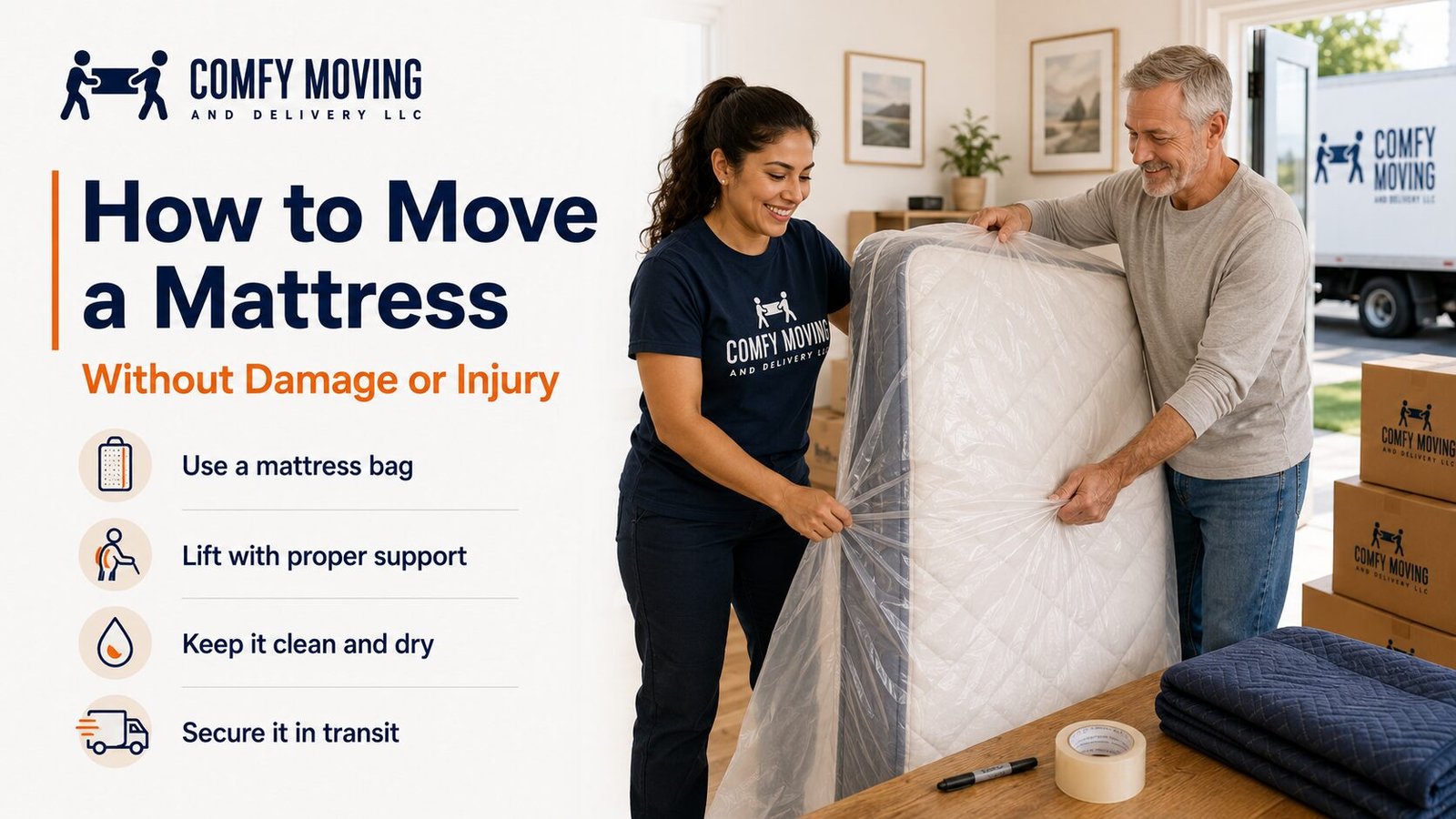
Stand the mattress upright against a clean wall. Open the mattress bag fully and slide it over the top. One person can hold the mattress steady while the other works the plastic downward.
Lift one lower corner at a time until the bag covers the mattress completely.
Another option is to spread the bag flat on the floor, place the mattress carefully on top, and pull the bag around it. Use this method only on a clean surface with enough room to work.
Once the mattress is inside:
- Smooth out large folds in the plastic.
- Fold over excess material.
- Seal the opening with packing tape.
- Reinforce the corners if the bag feels loose.
- Keep tape on the bag rather than the mattress fabric.
Do not wrap the mattress so tightly that the material becomes compressed or distorted. The bag should stay in place without changing the mattress’s shape.
Add Support to a Flexible Mattress
Foam mattresses and some hybrid models may fold or sag while being carried. That flexibility can make them harder to control around corners or on stairs.
Place one or two large cardboard sheets against the sides of the bagged mattress. Secure the cardboard with stretch wrap or straps without squeezing the mattress.
The cardboard creates a firmer surface and can help the mattress stay straighter during carrying.
Do not fold a mattress simply because it feels flexible. Some models can tolerate temporary bending, while others may be damaged by folding. Check the manufacturer’s care instructions before changing its shape.
Spring and coil mattresses should generally remain flat or upright without being folded.
Clear the Entire Carrying Path
A mattress can block the carriers’ view, so a route that seems clear may still contain hazards.
Before lifting:
- Move boxes away from doorways
- Remove rugs that can slide
- Secure pets in another room
- Keep children away from the route
- Prop open doors where practical
- Remove wall art near tight corners
- Check for low ceiling fixtures
- Clear the stairs
- Open the moving truck
- Prepare the loading area
Walk the route once without the mattress. Decide who will move backward, where turns will happen, and where the mattress can be rested safely if needed.
Avoid placing it on a dirty driveway, wet sidewalk, or rough pavement, even when it is inside a plastic bag. Sharp surfaces can puncture the plastic and damage the fabric underneath.
How to Lift a Mattress Safely
Proper lifting matters because a mattress combines weight with poor balance and limited handholds.
Use two or more people for queen, king, California king, thick hybrid, and heavy memory foam mattresses. Even when the weight seems manageable, the size may make the mattress difficult to control alone.
Before lifting:
- Wear shoes with closed toes and stable soles
- Put on work gloves for better grip
- Stand close to the mattress
- Keep your feet shoulder-width apart
- Bend at the knees
- Keep your back in a neutral position
- Lift with your legs
- Avoid twisting while carrying
Agree on simple commands such as:
- Lift
- Stop
- Lower
- Turn left
- Turn right
- Step up
- Step down
Both people should lift and lower at the same time. Sudden movement on one side can pull the other carrier off balance.
Furniture lifting straps can create more reliable handholds. Position them according to the manufacturer’s instructions and check that they cannot slip before moving.
Carrying a Mattress Through Doorways
Turn the mattress onto its side before approaching most standard doorways. This reduces the width and makes it easier to guide the corners through the opening.
Move slowly and watch the upper corners. They can catch on the door frame while the carriers focus on the floor.
For tight spaces:
- Move one upper corner through first.
- Angle the mattress slightly.
- Rotate the opposite corner through.
- Recenter the mattress after clearing the frame.
Do not force the mattress through an opening. Repeated pressure can tear the bag, scrape the fabric, or damage the doorway.
Removing the door from its hinges may provide several extra inches of clearance. Store the hinge pins and screws in a labeled bag.
Moving a Mattress Down Stairs
Stairs are one of the most difficult parts of the job because the mattress can block visibility and shift its weight toward the lower carrier.
Use at least two people. The stronger or more confident carrier will often take the lower position, but both people should agree on the arrangement before starting.
Keep the mattress upright and slightly angled with the staircase. Move one step at a time.
The lower carrier should not walk backward without guidance. The upper carrier can call out steps, landings, and turns.
Do not slide the mattress down the staircase. Even inside a protective bag, sliding can damage the mattress, tear the plastic, mark the stairs, or create an uncontrolled fall.
For narrow staircases, furniture straps may improve control. A professional moving crew is the safer option when the staircase is steep, curved, or too tight for clear communication.
Using a Dolly
A platform dolly can reduce carrying on flat surfaces such as hallways, sidewalks, loading docks, and parking areas.
Place the mattress upright on its side and center it on the dolly. One person should hold the mattress while another guides the dolly.
Secure the mattress with straps if the route is long or uneven.
A standard upright hand truck may work for a smaller mattress, but large mattresses can become top-heavy and difficult to steer. Do not use a dolly on stairs unless it is designed specifically for stair movement and the operator knows how to use it safely.
How to Move a Mattress by Yourself
Moving a mattress alone is safest only when the mattress is relatively small, the route is clear, there are no difficult stairs, and the vehicle is ready.
A twin or full mattress may be manageable with:
- A mattress bag
- Cardboard support
- A platform dolly
- Furniture straps
- A clear ground-level route
Stand the mattress upright and slide it onto the dolly rather than trying to carry the full weight. Keep one hand on the mattress while moving slowly.
Do not attempt a solo move when:
- The mattress blocks your vision
- You cannot lift it without bending your back
- The route includes stairs
- The mattress is a heavy queen or king
- The building has tight corners
- The mattress must be lifted high into a truck
- Windy outdoor conditions make it unstable
- You have a previous back, shoulder, or knee injury
Calling for help is less expensive than replacing a damaged mattress or recovering from an injury.
Prepare the Vehicle Before Loading
The vehicle should be ready before the mattress leaves the home.
Sweep the truck or van floor and remove nails, screws, broken wood, dirt, and moisture. Check that the loading space is large enough for the mattress without forcing it against sharp objects.
Plan the load so the mattress will not need to be repeatedly moved to make room for other furniture.
Keep ratchet straps within reach. Do not load the mattress first and then realize the straps are buried inside a box.
A moving truck or enclosed cargo van is usually the most practical choice because it protects the mattress from weather, road debris, and wind.
How to Load a Mattress Into a Moving Truck
Bring the mattress to the edge of the truck and pause before lifting. Make sure the ramp is stable and the truck floor is dry.
For a high truck bed, one person can stand inside the vehicle while the other remains below. Lift together and slide the mattress onto a clean section of the floor.
Do not drag exposed corners across the truck edge. The mattress bag may tear where it contacts metal.
The best loading position depends on the mattress type and the manufacturer’s instructions.
Spring and Coil Mattresses
These mattresses are usually firmer and may be transported upright on their side when properly supported and secured.
Keep them from bending around furniture. Use straps to hold the mattress against the truck wall or place it between broad, stable items.
Memory Foam Mattresses
Foam mattresses may flex more easily and often benefit from lying flat on a clean, supported surface.
Do not place heavy boxes or furniture on top. Concentrated weight can compress or distort the foam.
Hybrid Mattresses
Hybrid models contain both foam and coils, so they may be heavier and less flexible than expected.
Follow the manufacturer’s moving instructions. When possible, support the entire mattress and avoid sharp bends.
Box Springs and Foundations
A box spring or rigid foundation can usually travel upright or flat.
Protect the corners and fabric before loading. Keep it separate from objects that may puncture the lower covering.
Secure the Mattress Inside the Vehicle
A mattress should never be left loose inside a moving truck.
Even a heavy model can shift during braking, turning, or driving over uneven roads. That movement may damage the mattress and surrounding belongings.
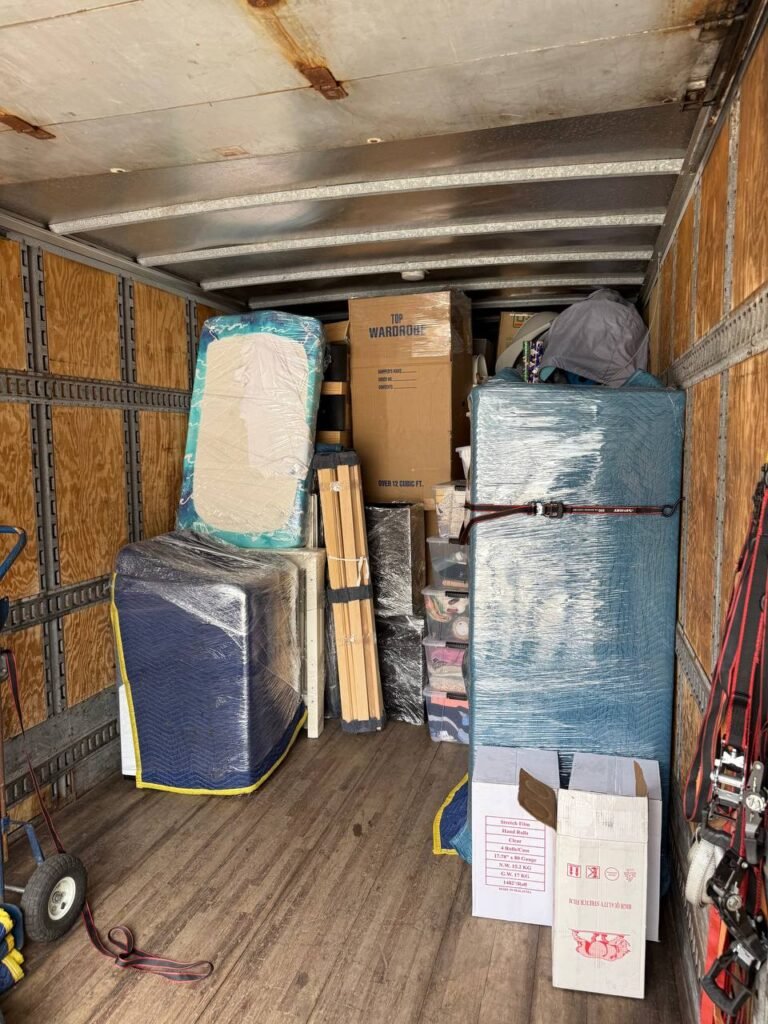
Use ratchet straps to secure it to the truck’s tie-down rails. Tighten the straps enough to stop movement without crushing the mattress.
Do not run a narrow strap directly across an unprotected foam surface. Add a moving blanket or broad cardboard layer under the strap to distribute pressure.
Keep sharp furniture corners, metal bed rails, tools, and open hardware away from the mattress.
Nothing heavy should be stacked on top of it.
Can You Tie a Mattress to the Roof of a Car?
Transporting a mattress on a car roof creates several problems. Wind can lift it, straps can loosen, the mattress can block visibility, and an improperly secured load can endanger other drivers.
An enclosed moving truck, cargo van, or suitable pickup is the better choice.
When roof transport is the only available option, confirm that it is permitted under local road rules and use equipment rated for the load. The mattress must be protected from weather and secured at several points to proper vehicle anchors.
Do not rely on light rope, bungee cords, or straps passed only through open windows.
Stop shortly after beginning the trip to inspect the load, and check it again during longer travel.
Hiring movers or renting the correct vehicle is usually safer than improvising with a passenger car.
Driving With a Mattress
Before leaving, walk around the vehicle and check every strap.
During transportation:
- Accelerate gradually
- Leave extra braking distance
- Take turns slowly
- Avoid sudden lane changes
- Watch for low branches and overhead structures
- Stop if the load appears to shift
- Recheck straps during long trips
An unsecured mattress is not merely at risk of damage. It may move into other belongings or become a road hazard.
Unloading the Mattress
Prepare the destination route before opening the truck.
Check the entrance, stairs, elevator, and bedroom. Remove boxes from the path and decide where the mattress will be placed.
Release straps while another person supports the mattress. A mattress leaning against the truck wall may shift suddenly once the tension is removed.
Carry it directly to the bedroom while it is still protected. Avoid removing the bag outdoors or in a shared hallway.
Place the mattress on a clean, stable foundation before cutting away the plastic. Keep scissors and blades pointed away from the fabric.
Let the Mattress Breathe
After the mattress is inside, remove the plastic bag and inspect the surface.
Allow it to air out before making the bed, especially when it has spent several hours inside a sealed bag or moving truck.
If the mattress was transported through rain, extreme heat, or cold conditions, give it time to return to indoor temperature.
Check for:
- Damp areas
- Torn fabric
- Bent corners
- New lumps or depressions
- Damage around seams
- Unusual odors
Do not cover or use a mattress that feels damp. Let it dry fully in a ventilated room.
How to Store a Mattress
A mattress going into storage needs more than a plastic cover and an empty corner.
Choose a clean, dry, temperature-controlled space whenever possible. Moisture and prolonged temperature changes can damage foam, fabric, adhesives, and internal components.
Clean and dry the mattress before bagging it.
Store it flat on a solid, supported surface unless the manufacturer provides different instructions. Long-term upright storage may cause some mattresses to bend or sag.
Do not place boxes, furniture, or heavy objects on top.
Keep the mattress off bare concrete. Use a clean platform, pallet, or suitable foundation to reduce contact with floor moisture.
Inspect the storage area for leaks and pests before leaving the mattress.
Common Mattress Moving Mistakes
Skipping the Mattress Bag
Moving blankets alone may leave areas exposed to dirt or moisture. A sealed mattress bag provides more complete surface protection.
Carrying a Large Mattress Alone
A mattress may not feel extremely heavy, but its width and flexibility make it difficult to balance. Large mattresses should usually be handled by at least two people.
Dragging It Across the Floor
Dragging can tear the bag, damage the fabric, and collect dirt. Use a dolly or lift the mattress completely.
Folding Without Checking
Some foam mattresses can tolerate limited bending, while many coil and hybrid models should not be folded. Follow the manufacturer’s instructions.
Using Loose Rope
Improvised knots can slip under tension. Use properly rated straps attached to secure anchor points.
Blocking the Carrier’s View
A mattress held directly in front of the body can hide stairs, curbs, boxes, and door frames. Carry it from the sides and use a second person as a guide.
Loading Heavy Items on Top
Boxes and furniture can compress the materials or create permanent dents. Keep the mattress free from stacked weight.
Sealing a Damp Mattress
Moisture trapped inside plastic can create odors and damage. The mattress should be completely dry before packing.
When Professional Mattress Moving Makes Sense
A small mattress in a ground-floor apartment may be manageable with a friend and a dolly. A heavy king mattress on a curved staircase is a different job.
For stairs, tight turns, and loading help, Comfy Moving’s labor only movers can provide the extra hands and equipment needed for safer handling.
Comfy Moving handles mattress protection, bed disassembly, carrying, loading, transportation, unloading, and basic furniture placement as part of residential moving support.
Professional help may be worthwhile when:
- The mattress is queen size or larger
- The route includes stairs
- The building has narrow hallways
- The mattress is unusually thick or heavy
- You do not have a suitable vehicle
- The move is long-distance
- The mattress must go into storage
- The bed frame is complicated to disassemble
- You have limited time or mobility
- Several bedrooms need to be packed and moved
You can arrange a full-service move or request labor-only help for lifting, loading, unloading, and in-home furniture movement.
Frequently Asked Questions
What Is the Best Way to Move a Mattress?
The best method is to place the clean, dry mattress in a correctly sized protective bag, carry it with at least one helper, and secure it inside an enclosed moving vehicle. Keep the mattress supported according to its construction and avoid placing heavy items on top.
Do You Need a Mattress Bag for Moving?
A mattress bag is strongly recommended. It protects the fabric from dust, dirt, moisture, floors, walls, and other items in the moving truck.
Can You Fold a Mattress for Moving?
It depends on the mattress. Some all-foam models may tolerate temporary bending, while spring and many hybrid mattresses may be damaged by folding. Check the manufacturer’s instructions first.
Can One Person Move a Mattress?
One person may be able to move a small mattress using a dolly and straps on a clear, level route. Larger mattresses, stairs, and high truck beds generally require at least two people.
Should a Mattress Be Transported Flat or Upright?
The correct position depends on the mattress construction and the manufacturer’s guidance. Foam mattresses often need broad support, while firmer spring models may travel upright when properly secured.
Can You Put Boxes on Top of a Mattress?
Avoid placing heavy boxes or furniture on top. Weight can compress the mattress, damage internal materials, and create lasting depressions.
How Do You Move a Mattress Down Stairs?
Use at least two people, keep the mattress controlled from both ends, move one step at a time, and communicate throughout the descent. Furniture straps can improve grip, but tight or curved stairs may require professional movers.
How Long Can a Mattress Stay in a Plastic Bag?
A mattress bag is useful during moving and short-term protection. For longer storage, the mattress should be completely dry and kept in suitable conditions. Follow the manufacturer’s storage recommendations and inspect it periodically.
Protect the Mattress and the People Carrying It
The central lesson in how to move a mattress is that size matters just as much as weight.
A mattress can be difficult to grip, hard to see around, and unpredictable when it bends. The safest approach is to prepare the route, use a proper cover, bring enough help, lift with control, and secure the mattress before the vehicle moves.
A little planning can prevent stained fabric, damaged foam, scratched walls, and painful injuries.
Comfy Moving can take care of the mattress, bed frame, loading, transportation, and placement in the new bedroom, so one of the most awkward items in the home does not become the hardest part of moving day.
Services that match this moving topic