

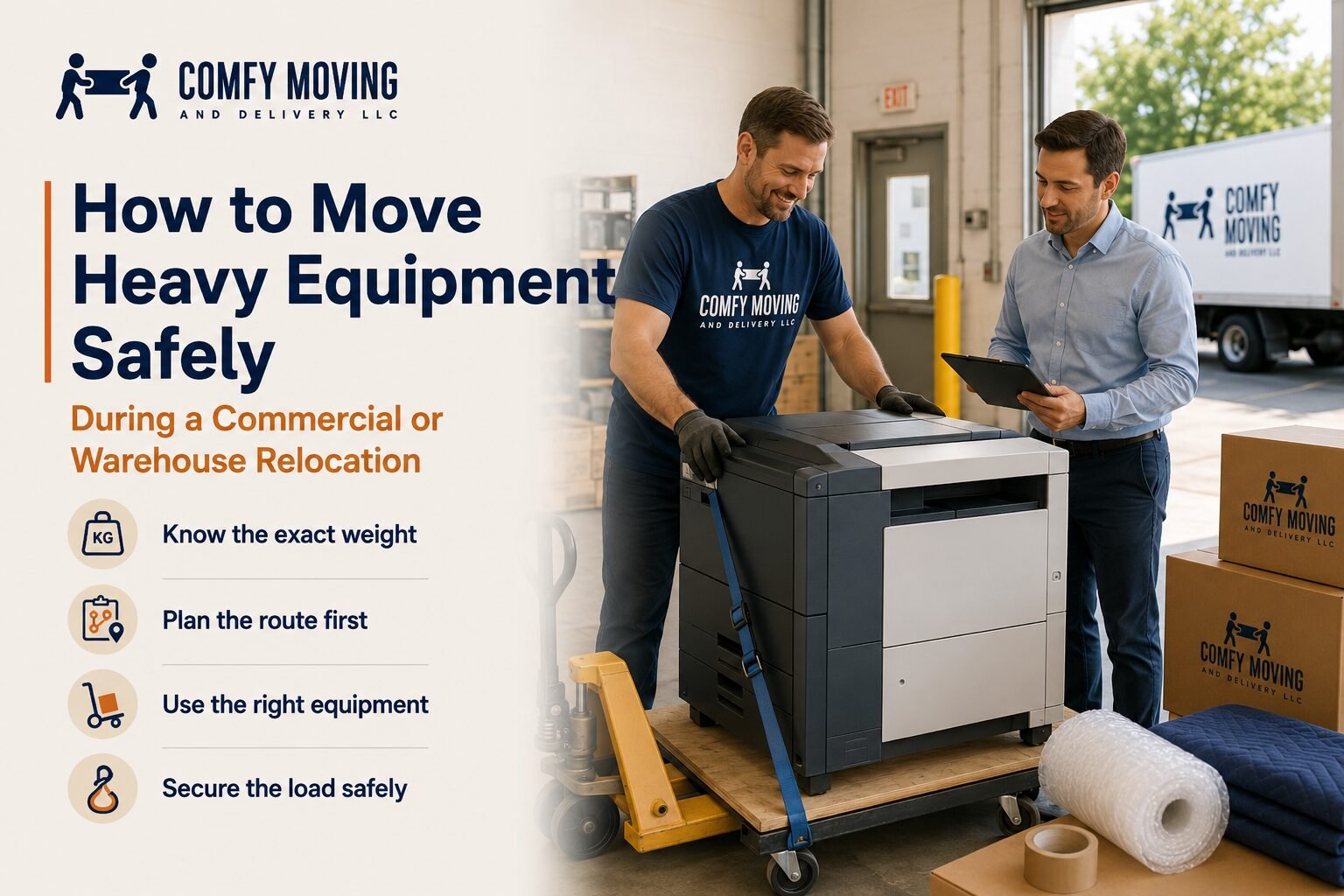
How to Move Heavy Equipment Safely During a Commercial or Warehouse Relocation
A commercial move gets complicated the moment someone points at a machine and says, “That needs to go too.”
Office chairs and boxed files are predictable. Heavy equipment is not.
A commercial printer may weigh several hundred pounds but contain sensitive internal components. A shop machine can be compact enough to fit through a doorway while still being far too heavy for ordinary moving techniques. Warehouse equipment may need to cross a loading dock, ramp, polished concrete floor, narrow corridor, or elevator before it ever reaches the truck.
That is why learning how to move heavy equipment is less about finding the strongest people in the building and more about answering the right questions before anything moves.
What does the equipment weigh? Where is its center of gravity? Can parts be removed? Does it have fluids, batteries, compressed systems, or sensitive components? Can the floor support it? Will it clear every doorway? What equipment is needed to lift it safely? Can a standard commercial moving truck handle it, or does the job require a specialized machinery carrier?
A good relocation plan answers those questions first.
What Counts as Heavy Equipment in a Commercial Move?
“Heavy equipment” can mean very different things depending on the business.
In a warehouse, it may include material-handling equipment, workstations, industrial shelving components, palletized machinery, large tools, or production equipment.
In an office or retail environment, the difficult items may be:
- Large copiers and commercial printers
- Server racks
- Commercial safes
- Vending equipment
- Industrial worktables
- Large filing systems
- Medical or laboratory equipment
- Commercial kitchen equipment
- Shop machinery
- Manufacturing equipment
- Heavy storage systems
- Large displays and fixtures
Some of these items can be handled within a conventional commercial relocation using trained movers, dollies, lift gates, pallet jacks, protective materials, and appropriate loading equipment.
Others cannot.
Construction machinery, oversized industrial machines, unusually tall loads, or equipment weighing many thousands of pounds may require cranes, rigging contractors, lowboy trailers, removable gooseneck trailers, oversize permits, escort vehicles, or other services outside the scope of a normal commercial moving crew.
The first rule is therefore simple: identify what kind of move you actually have.
Start With an Equipment Inventory
Before deciding how to move heavy equipment, create an inventory of everything that needs to leave the building.
Do not list an item merely as “machine.”
Record information that affects how it will be moved:
- Equipment name
- Manufacturer
- Model number
- Approximate weight
- Length
- Width
- Height
- Current location
- Destination location
- Whether it can be disassembled
- Whether it has wheels
- Whether it needs to remain upright
- Whether it contains liquids
- Whether it has a battery
- Whether it requires calibration
- Whether it has sensitive electronics
- Whether the manufacturer provides transportation instructions
Photograph the equipment from several angles as well.
Pictures help the moving team understand the shape, access points, protruding components, control panels, and surrounding workspace before arriving.
For complicated equipment, photos of the route are useful too.
Get the Actual Weight
Guessing the weight of commercial equipment is one of the easiest ways to create a dangerous moving plan.
Appearance is misleading.
A relatively small piece of machinery may contain a dense steel frame, motor, counterweight, or internal assembly that makes it far heavier than expected.
Look for the weight in:
- Manufacturer specifications
- Equipment manuals
- Identification plates
- Technical documentation
- Purchase records
If components will be removed before moving, determine whether the published weight refers to the complete machine or the configuration you will actually transport.
Why does this matter?
Because every piece of moving equipment has a limit.
That includes:
- Dollies
- Pallet jacks
- Lift gates
- Forklifts
- Ramps
- Elevators
- Trailers
- Trucks
- Straps
- Building floors
The phrase “it should probably hold it” has no place in a heavy equipment move.
Measure More Than the Machine
Once you know the machine dimensions, measure the route.
That means every part of it.
Check:
- Doorways
- Hallways
- Stairwells
- Elevators
- Loading docks
- Freight entrances
- Gates
- Ramps
- Ceiling clearance
- Overhead pipes
- Sprinkler systems
- Lighting fixtures
- Exterior access points
A machine that clears a doorway by half an inch on paper may still be difficult to move if handles, hinges, trim, wheels, or control panels reduce the usable space.
Measure the destination too.
You do not want a piece of equipment successfully removed from one warehouse only to arrive at another building where it cannot reach its planned position.
Check Floor Capacity and Surface Conditions
Heavy equipment puts far more stress on flooring than ordinary office furniture.
The total machine weight is only part of the equation.
A heavy load concentrated on four small wheels may place much more pressure on a surface than the same weight distributed across a large base.
Before moving, inspect the route for:
- Uneven concrete
- Floor drains
- Expansion joints
- Cracks
- Raised thresholds
- Slopes
- Soft flooring
- Tile
- Loading dock gaps
- Temporary floor coverings
Do not assume that every interior floor or elevator can support industrial equipment.
Building management or a structural professional may need to confirm capacity for unusually heavy loads.
This is particularly important in multi-story commercial buildings.
Create a Route Before Moving Day
The shortest route is not always the safest route.
A slightly longer path may avoid:
- Sharp turns
- Narrow doors
- Passenger elevators
- Customer areas
- Stairs
- Delicate flooring
- Low ceilings
- Active work zones
Walk the route in advance.
Imagine moving the equipment at its full width, not simply walking through the space yourself.
Then clear the path.
Remove boxes, carts, trash bins, loose cords, furniture, floor mats, temporary signage, and anything else that could interfere with the crew or equipment wheels.
A commercial relocation is much easier when nobody needs to improvise while supporting a heavy load.
Coordinate With Building Management
Commercial buildings often have moving rules that homes do not.
Before scheduling the relocation, confirm:
- Loading dock hours
- Freight elevator reservations
- Parking restrictions
- Certificate of Insurance requirements
- Security procedures
- Vendor access rules
- Protective floor covering requirements
- After-hours access
- Noise limitations
- Dock height
- Elevator dimensions
- Elevator capacity
Some buildings allow commercial moves only during evenings or weekends.
Comfy Moving’s commercial moving services are designed around business relocations, including offices, retail locations, warehouses, equipment, and moves where scheduling has to work around normal operations.
Read the Manufacturer’s Transportation Instructions
The people who designed a machine usually know where it is vulnerable.
Check the manual before disconnecting, tilting, dismantling, or lifting equipment.
The manufacturer may specify:
- Approved lifting points
- Components that must be removed
- Components that must be locked
- Maximum permitted tilt
- Transportation orientation
- Shipping brackets
- Internal restraints
- Fluid draining procedures
- Battery procedures
- Calibration requirements after relocation
Do not invent lifting points because a frame “looks strong.”
A cover, rail, handle, or guard may not be structural.
Using the wrong point can damage the equipment before it leaves the room.
Shut Down Equipment Properly
Commercial machinery should not simply be unplugged and pushed toward the door.
The shutdown procedure depends on the equipment.
It may involve:
- Powering down software correctly
- Disconnecting electrical power
- Closing water supplies
- Disconnecting compressed air
- Isolating gas connections
- Removing detachable batteries
- Draining approved fluids
- Securing movable components
- Allowing equipment to cool
Electrical, gas, hydraulic, refrigeration, or other specialized disconnections should be handled by qualified personnel when required.
Movers should receive equipment that has been safely prepared for relocation.
Do not ask a moving crew to improvise technical disconnection work that belongs to a licensed technician or the equipment manufacturer’s service team.
Back Up Data Before Moving Electronic Equipment
If the equipment contains computers, controllers, stored settings, or production data, create backups before relocation.
Physical protection cannot eliminate every risk.
A machine may arrive without a scratch and still develop an electronics problem.
Before shutdown:
- Back up essential files or settings.
- Document configuration information.
- Photograph cable connections.
- Label cables.
- Record network settings where relevant.
- Confirm who will recommission the equipment.
For IT-heavy commercial moves, treating configuration data as part of the moving inventory can save hours after arrival.
Remove Loose and Detachable Components
Heavy equipment becomes easier to protect when fragile pieces are not sticking out from every side.
Where the manufacturer allows it, remove:
- Trays
- Screens
- Tool holders
- Shelves
- Accessories
- Removable handles
- Control arms
- Detachable guards
- External cables
- Loose attachments
Label everything.
Put hardware in sealed bags or containers and mark them with the equipment ID.
Do not create a box labeled simply “machine parts” when six machines are moving at the same time.
A good labeling system might read:
Equipment 04 – CNC Station – Rear Panel Hardware
That takes a few seconds now and can save a long search later.
Protect Sensitive Parts Before Protecting the Exterior
A moving blanket around the cabinet does not automatically protect the machine.
Start with the parts most likely to be damaged.
These may include:
- Displays
- Control panels
- Glass
- Sensors
- Ports
- Levers
- Exposed wiring
- Precision surfaces
- Adjustment knobs
- Protruding components
Use protection appropriate for the surface and equipment.
Then protect the larger exterior.
Depending on the item, professional movers may use:
- Moving blankets
- Corner protection
- Foam
- Stretch wrap
- Crating
- Protective panels
- Strapping
- Pallets
Avoid placing adhesive directly on sensitive finishes or controls unless the manufacturer allows it.
Decide How the Equipment Will Move Across the Building
There is no single correct tool for every heavy item.
The equipment, weight, floor, route, and building access determine what should be used.
Heavy-Duty Dollies
Dollies may work well for equipment that has a stable shape, manageable dimensions, and a weight within the dolly’s rated capacity.
The load needs to be properly centered and controlled.
Pallet Jacks
A pallet jack can make moving palletized equipment across smooth, level floors much easier.
It is not a universal solution.
Thresholds, ramps, slopes, cracked concrete, and uneven surfaces can change the situation quickly.
Machinery Skates
Specialized machinery skates may be used for certain heavy machines that need to move across a flat surface.
The machine must be properly supported, the equipment must be rated for the load, and the route must remain controlled.
Forklifts
Forklifts are common in warehouses, but having a forklift nearby does not automatically make it the correct lifting tool.
The operator must be trained, the forklift must have adequate rated capacity, and the machine must have appropriate lifting or support points.
Fork length, load center, floor conditions, clearance, and equipment balance all matter.
Lift Gates
For equipment within the rated capacity and dimensional limits of the vehicle, a commercial truck lift gate may simplify loading and unloading.
The load still needs to be balanced, restrained, and controlled.
Cranes and Professional Rigging
Some machines are beyond conventional moving equipment.
If the equipment requires lifting through a window, over a barrier, from a recessed pit, or has extremely high weight or difficult geometry, a specialized rigging company may be necessary.
Knowing when regular commercial moving equipment stops being appropriate is part of knowing how to move heavy equipment safely.
Never Exceed Rated Capacity
Every piece of equipment involved in the move should have a known working capacity.
That includes the equipment used to move the equipment.
Do not exceed the rated limit of a:
- Dolly
- Pallet jack
- Forklift
- Lift gate
- Ramp
- Elevator
- Hoist
- Strap
- Truck
Do not compensate for inadequate equipment by adding more people.
Four people pushing an overloaded cart do not increase the cart’s rated capacity.
Understand the Center of Gravity
Two machines with the same weight can behave very differently.
One may have most of its mass near the base.
Another may have a motor or internal assembly mounted high on one side.
The second machine can become unstable much faster when tilted.
Manufacturer documentation may provide information about the center of gravity or lifting points.
For unusual machinery, a qualified equipment technician or rigger may need to determine how the load should be supported.
Avoid experimenting with tilt after the machine is already on a ramp.
Keep the Load Controlled
Heavy equipment should never be moved faster than the crew can stop it.
Slow movement is usually good movement.
This matters around:
- Ramps
- Slopes
- Dock plates
- Elevator entrances
- Floor transitions
- Corners
- Narrow doors
One person should coordinate the movement.
Commands should be simple and agreed on before starting.
For example:
- Stop
- Move
- Left
- Right
- Lower
- Hold
If anyone loses visibility or control, stop.
Restart only when everyone understands what happens next.
Keep People Out of the Crush Zone
No schedule is important enough to put someone between a heavy machine and a wall.
Plan the move so workers do not need to place hands, feet, or bodies beneath or behind an uncontrolled load.
Never use a person as a physical stop.
Avoid standing directly in the travel path of equipment on a slope.
Keep employees who are not involved in the move away from the work area.
For active businesses, barriers or temporary access restrictions may be needed while the equipment travels through the building.
Protect Commercial Floors
A warehouse floor may look nearly indestructible until a concentrated heavy load travels across a vulnerable section.
Offices, retail spaces, and showrooms can be even more sensitive.
Before moving equipment, determine whether the route needs:
- Floor runners
- Protective panels
- Plywood
- Mats
- Suitable load-distribution materials
Protection should not create a new hazard.
Loose material that shifts under wheels can be worse than no protection at all.
The correct method depends on both the equipment and the floor.
Protect Walls, Doors, and Building Infrastructure
Commercial equipment can damage more than flooring.
Watch for:
- Door frames
- Glass doors
- Drywall corners
- Elevator interiors
- Wall-mounted signs
- Fire equipment
- Sprinkler pipes
- Ceiling fixtures
- Security sensors
- Loading dock doors
Padding narrow doorways and corners can help, but clearance remains more important than padding.
Protective blankets do not make an oversized machine smaller.
Loading Heavy Equipment Into a Truck
Once the machine reaches the loading area, the job changes.
Now the questions are:
- Is the truck appropriate?
- Can the lift gate or ramp support the load?
- Where should the machine sit?
- How will the weight be distributed?
- What will prevent movement during transportation?
Do not treat the cargo area as a large empty room where equipment can be placed anywhere.
Weight distribution affects vehicle handling.
Heavy items generally need to be positioned according to the truck’s load plan and secured so they cannot slide, tip, roll, or collide with other equipment.
Use the Correct Vehicle
Some commercial equipment fits comfortably within an enclosed moving truck.
Other machinery may require a specialized trailer.
The right vehicle depends on:
- Weight
- Height
- Width
- Length
- Ground clearance
- Loading method
- Whether the machine can travel enclosed
- Whether it is considered oversize
- Route restrictions
Specialized heavy-haul transport may use flatbeds, step-deck trailers, lowboys, or removable gooseneck trailers for machinery that cannot be transported in a conventional moving truck.
If a load falls into that category, bring in a carrier equipped and licensed for that kind of transportation.
Do not try to make oversized machinery fit a standard commercial move simply because both locations are nearby.
A Short Move Still Requires Securement
One of the most expensive misconceptions is:
“It’s only going five miles.”
Distance does not eliminate braking.
A machine can move inside a truck during:
- Hard stops
- Sharp turns
- Lane changes
- Potholes
- Driveway transitions
- Ramp movement
Even a low-speed collision between two heavy machines can damage both.
Secure each load appropriately before the truck moves.
Keep Equipment Separate From Loose Cargo
Do not surround an expensive machine with loose metal shelving, tools, hardware, or unrestrained furniture.
A machine can be perfectly strapped in place and still be damaged by something else hitting it.
Use padding, spacing, barriers, and an organized loading plan.
Sensitive machinery should not become the wall that holds the rest of the truck together.
Plan the Unload Before Leaving the Origin
Do not wait until the truck arrives to ask where the machine belongs.
Before transportation, confirm:
- Exact destination room
- Door dimensions
- Loading access
- Elevator availability
- Floor protection
- Final orientation
- Power connection location
- Utility connections
- Clearance around the equipment
Place equipment as close to its final operating position as safely practical.
Moving it “somewhere inside for now” may mean repeating the hardest part of the job a week later.
Let Technicians Handle Recommissioning
A commercial mover can place equipment in position, but restarting specialized machinery may require someone else.
Depending on the machine, final setup may involve:
- Electrical connection
- Plumbing
- Compressed air
- Gas
- Network configuration
- Anchoring
- Calibration
- Leveling
- Software testing
- Manufacturer inspection
Schedule the appropriate technician before moving day when possible.
That helps reduce downtime between delivery and operation.
Inspect Equipment After Arrival
Before removing every piece of protection, compare the machine with the condition photos taken at origin.
Check:
- Exterior panels
- Screens
- Controls
- Doors
- Guards
- Cables
- Connections
- Attachments
Document anything unusual.
If equipment requires calibration or startup testing, do not skip that step simply because it looks fine externally.
Precision machines can be affected by relocation without showing obvious cosmetic damage.
How to Move Heavy Equipment Between Warehouses
Warehouse moves create a particular set of challenges because heavy equipment often shares space with inventory, racking, forklifts, pallets, and active operations.
A practical sequence is usually:
- Inventory the equipment.
- Determine which machines require technicians.
- Confirm weights and dimensions.
- Map the origin and destination routes.
- Schedule dock access.
- Identify the correct moving equipment.
- Shut down and prepare each machine.
- Remove and label attachments.
- Protect vulnerable components.
- Relocate equipment in a planned order.
- Position machines at the destination.
- Reconnect and test them.
The order matters.
If the largest machine belongs at the rear of the new production area, it may need to arrive before shelving, worktables, or boxes fill the route.
Think about installation order while creating the loading order.
Moving Equipment While Keeping a Business Open
Not every company can close for several days.
If operations need to continue, divide the relocation into stages.
For example:
Phase 1: Nonessential inventory and furniture
Phase 2: Backup equipment
Phase 3: Main operational equipment
Phase 4: Remaining furniture, files, and supplies
Phase 5: Final setup and cleanup
Some businesses benefit from evening or weekend moving so machines can be shut down after the workday and brought online before normal operations resume.
Comfy Moving’s commercial relocation service includes flexible scheduling for businesses that need to reduce disruption during the move.
When Labor-Only Movers Can Help
Sometimes the transportation is already arranged.
A company may have:
- Its own truck
- A rental truck
- A freight carrier
- A storage container
- A warehouse transfer vehicle
In that situation, labor-only movers can help with appropriate loading, unloading, carrying, placement, and other physical moving work without providing the transportation itself.
This can be useful for commercial moves where the business has already solved one part of the logistics but still needs a trained moving crew.
For unusually heavy machinery, confirm the exact equipment specifications before booking so the required tools and scope can be assessed properly.
When You Need a Specialized Heavy-Haul Carrier Instead
A conventional commercial moving company and a heavy-haul carrier are not interchangeable.
You may need specialized transportation when equipment:
- Cannot fit inside a standard moving truck
- Exceeds normal vehicle weight limits
- Requires a lowboy or specialized trailer
- Requires a crane for loading
- Requires professional industrial rigging
- Exceeds legal width or height limits
- Needs oversize permits
- Requires escort vehicles
- Has unusual hazardous-material requirements
- Cannot be handled with standard commercial moving equipment
In these cases, use a company equipped for that exact class of machinery.
This distinction protects the equipment, the building, the moving crew, and everyone sharing the road.
Common Heavy Equipment Moving Mistakes
Guessing the Weight
Heavy machinery should never be matched to lifting equipment based on appearance.
Use documented specifications.
Measuring Only the Machine
Measure the route, elevator, dock, truck opening, and destination too.
Disconnecting Specialized Equipment Without a Technician
Movers move equipment.
Licensed electrical, gas, refrigeration, hydraulic, or technical work should remain with the appropriate professionals.
Forgetting About the Center of Gravity
A machine can tip even when the dolly beneath it is technically rated for the weight.
Balance matters.
Using the Wrong Dolly or Pallet Jack
Capacity is only one factor.
The tool must also suit the equipment shape and route.
Ignoring Floor Conditions
Small wheels and enormous weight are not a friendly combination on cracked concrete or raised thresholds.
Rushing on a Ramp
Momentum is not a moving technique.
Heavy loads should remain controlled throughout the move.
Failing to Secure the Machine Inside the Truck
Reaching the truck is only half the job.
The machine must remain stable for the entire trip.
Letting Employees “Help for a Minute”
Untrained people entering the moving area can make coordination harder rather than easier.
Assign clear roles and keep unnecessary personnel out of the work zone.
Planning the Destination After Loading
Know where every major machine is going before transportation begins.
Otherwise, the unload can become a second relocation.
Heavy Equipment Moving Checklist
Before the Move
- Identify every piece of equipment
- Record manufacturer and model
- Confirm exact or manufacturer-listed weight
- Measure equipment dimensions
- Photograph current condition
- Find transportation instructions
- Identify approved lifting points
- Measure all doors and corridors
- Confirm elevator dimensions and capacity
- Inspect floor conditions
- Reserve loading docks and freight elevators
- Determine whether technicians are required
- Back up electronic data and settings
- Create an equipment labeling system
- Choose the appropriate moving equipment
- Confirm vehicle capacity
- Identify anything requiring specialized rigging or heavy-haul transport
During Preparation
- Shut equipment down properly
- Disconnect utilities through qualified personnel where required
- Drain permitted fluids if required
- Secure moving components
- Remove approved detachable parts
- Label cables and accessories
- Protect screens and control panels
- Wrap or crate equipment as appropriate
- Clear the moving route
- Install floor and doorway protection
During the Move
- Keep unauthorized personnel away
- Assign one person to coordinate movement
- Stay within all rated equipment capacities
- Keep the load balanced
- Move slowly around transitions and turns
- Avoid pinch and crush zones
- Keep ramps and loading areas clear
- Stop immediately if control is lost
In the Truck
- Position equipment according to the load plan
- Protect machinery from nearby cargo
- Secure every heavy item
- Prevent rolling, tipping, and sliding
- Recheck securement before departure
At the New Location
- Confirm the route is clear
- Protect destination floors
- Place machinery in its planned position
- Inspect for visible damage
- Reinstall approved components
- Schedule technical reconnection
- Level or anchor equipment if required
- Restore software settings
- Calibrate equipment when necessary
- Test before returning it to service
Frequently Asked Questions
What is the safest way to move heavy equipment?
Start by confirming the equipment’s weight, dimensions, center of gravity, transportation instructions, and route. Use moving or lifting equipment rated for the load, protect sensitive components, keep people out of crush zones, and secure the equipment properly during transportation.
Can regular movers move heavy equipment?
It depends on what “heavy equipment” means. Commercial movers may handle heavy office equipment, warehouse equipment, commercial fixtures, certain machines, and other large business items within their equipment and vehicle limits. Oversized construction machinery or equipment requiring cranes, industrial rigging, permits, or specialized heavy-haul trailers should be handled by specialists.
How do you move heavy machinery across a warehouse?
The method depends on weight, shape, floor conditions, and manufacturer requirements. Appropriate options may include rated dollies, pallet jacks, machinery skates, forklifts, or other specialized equipment operated by trained personnel. The route should be cleared and inspected before the move begins.
How do I know how much a machine weighs?
Check the manufacturer manual, specification sheet, identification plate, technical documentation, or purchase records. Do not estimate equipment weight by appearance when selecting lifting or moving equipment.
Should machinery be disassembled before moving?
Sometimes. Removing manufacturer-approved detachable parts can reduce dimensions, weight, and damage risk. Never dismantle technical components without checking the equipment manual or using a qualified technician.
How do you protect machinery during a commercial move?
Protection can include moving blankets, foam, stretch wrap, corner protection, crates, pallets, and other materials appropriate for the equipment. Screens, sensors, controls, glass, and protruding components should receive attention before the exterior is wrapped.
Can a forklift be used to move any heavy machine?
No. The forklift must have sufficient rated capacity, an appropriate load center, enough fork length, suitable access, and a trained operator. The machine must also have safe support or lifting points.
Can heavy equipment be transported in a regular moving truck?
Some commercial equipment can. Large or oversized machinery may require flatbeds, lowboy trailers, removable gooseneck trailers, cranes, permits, or other specialized heavy-haul services. The vehicle should be selected based on the actual dimensions and weight of the equipment.
How far in advance should a warehouse equipment move be planned?
The more complicated the equipment, the earlier the planning should begin. Moves involving technicians, freight elevators, loading docks, shutdown schedules, specialized equipment, or multiple machines need more coordination than ordinary office relocations.
How can a business reduce downtime during an equipment move?
Prepare the destination before moving day, back up machine settings, relocate equipment in operational phases, schedule technicians in advance, label everything clearly, and consider evening or weekend relocation when practical.
Heavy Equipment Moves Better on Paper First
The most important part of how to move heavy equipment happens before the first dolly rolls across the warehouse floor.
Someone confirms the weight.
Someone checks the doorway.
Someone notices the machine needs a technician before disconnection.
Someone reserves the freight elevator.
Someone figures out that the destination corner needs to stay empty until the largest machine arrives.
Those small decisions are what keep a commercial move from turning into an expensive sequence of surprises.
Comfy Moving handles commercial relocations throughout Orange County, including offices, retail spaces, warehouses, furniture, IT assets, and appropriate business equipment. We can plan the moving route, protect the property, handle the physical relocation, load and unload the truck, and coordinate the move around your operating schedule.
And when a machine crosses the line from commercial moving into industrial rigging or specialized heavy hauling, that should be identified before moving day, not while the equipment is sitting at the loading dock.
Heavy equipment does not reward improvisation.
Measure it, plan for it, use the right equipment, and move it once.
Services that match this moving topic