

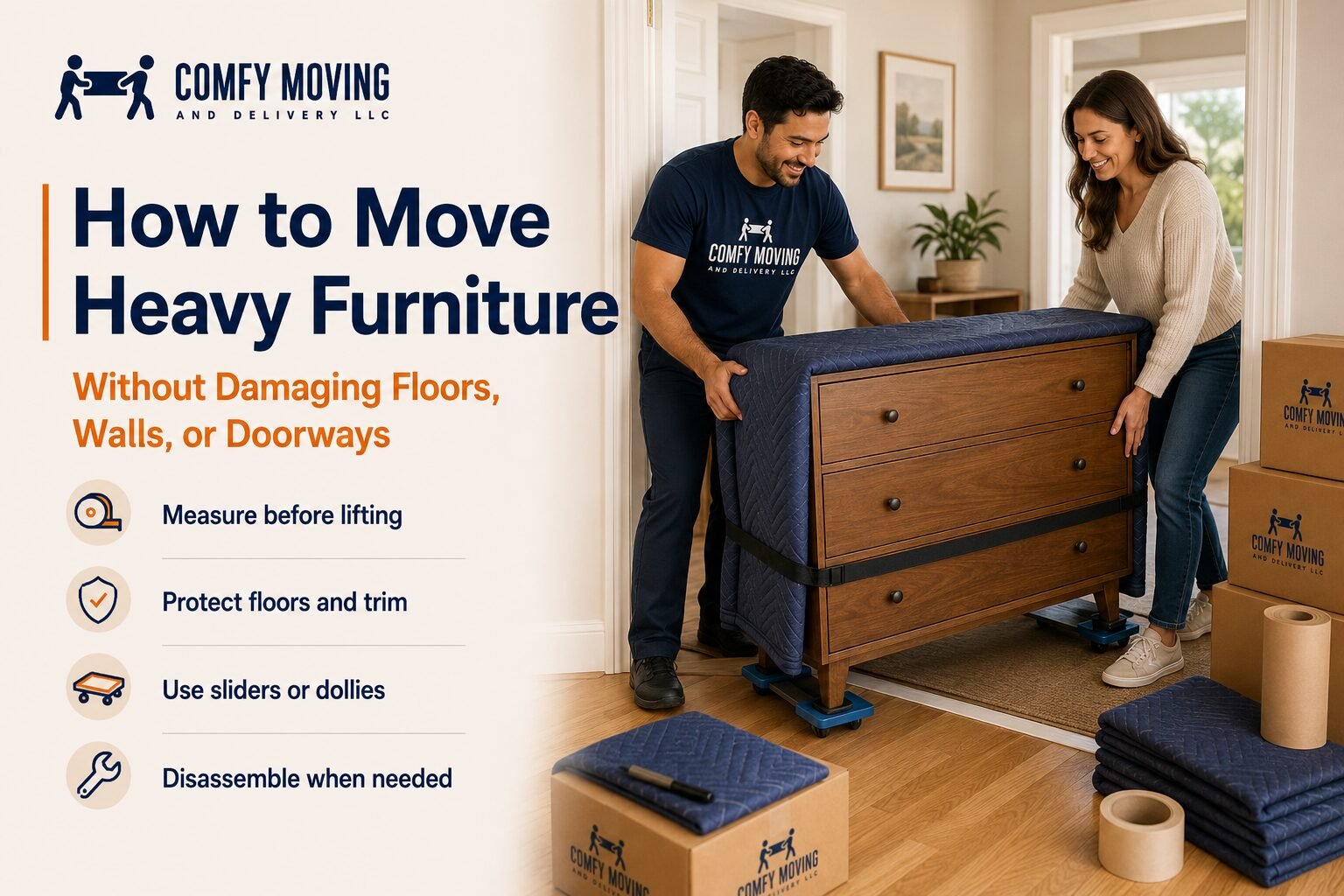
How to Move Heavy Furniture Without Damaging Floors, Walls, or Doorways
A sofa rarely feels enormous until it is halfway through a doorway.
The same dresser that sat quietly against a bedroom wall for six years can suddenly become a 200-pound geometry problem. One corner catches the trim. A leg threatens the hardwood. Someone is walking backward. The hallway is narrower than anyone remembered.
That is why learning how to move heavy furniture is less about raw strength and more about preparation, leverage, protection, and knowing when a piece needs to come apart before it moves an inch.
The safest approach is simple: make the furniture lighter where possible, plan the route before lifting, protect every surface that could take a hit, and use equipment that lets the weight work with you instead of against you.
This guide covers the full process, from measuring a sectional to getting a dresser down the stairs without leaving a trail of dents behind.
Why Heavy Furniture Causes So Much Moving Damage
Heavy furniture creates problems in two ways.
First, there is the weight itself. Dressers, solid wood tables, sectionals, cabinets, desks, sleeper sofas, and large bed frames can be difficult to control once they are off the ground.
Second, there is the shape.
A piece does not need to be extraordinarily heavy to be difficult to move. Long sofas, tall wardrobes, wide headboards, and awkward L-shaped desks can create more trouble than smaller items that weigh significantly more.
Common damage includes:
- Scratched hardwood
- Torn vinyl or laminate
- Cracked tile
- Dented drywall
- Chipped door frames
- Scraped baseboards
- Broken furniture legs
- Damaged corners
- Torn upholstery
- Strained backs, shoulders, hands, or knees
Most of these problems happen when people start moving before they have actually planned the move.
Start by Measuring the Furniture
Before lifting anything, measure it.
You need to know:
- Width
- Height
- Depth
- Diagonal depth when relevant
- Height with legs attached
- Height without removable legs
Then measure the route.
Check:
- Interior doorways
- Exterior doors
- Hallways
- Staircases
- Stair landings
- Elevator doors
- Elevator interiors
- Gates
- Garage openings
- Tight corners
- Low ceilings
- Railings
Do not measure only the narrowest doorway and assume the rest will work.
A sofa may fit through the front door but fail at a 90-degree hallway turn. A dresser may clear the stair width but become impossible to rotate on the landing.
The best time to find out is while the furniture is still sitting on the floor.
Measure the Doorway, Not Just the Door
One small detail causes a surprising number of problems: measuring the door itself instead of the actual opening.
The usable opening may be reduced by:
- Hinges
- Door handles
- Door stops
- Trim
- Thresholds
- Security hardware
If a piece is extremely close to fitting, removing the door from its hinges may create the extra clearance you need.
Do not force furniture through a doorway simply because it is “almost there.”
That last inch is usually where upholstery tears, trim cracks, or fingers get trapped.
Plan the Entire Route Before Anyone Lifts
Walk from the furniture’s current location all the way to the truck, storage container, elevator, or destination room.
Look at the path as if you were already carrying something too heavy to stop easily.
Remove:
- Area rugs
- Pet bowls
- Shoes
- Boxes
- Toys
- Floor lamps
- Small tables
- Loose cables
- Doorstops
- Plants
Make sure every door that needs to stay open can remain open without someone standing there holding it.
If you are moving through an apartment building, check elevator reservations, loading access, hallway restrictions, and any protective requirements before moving day.
A clear route lets the crew focus on the furniture instead of reacting to surprises while holding it.
Decide Whether the Furniture Should Be Disassembled
One of the easiest ways to move something heavy is to stop moving it as one heavy object.
Whenever the piece was designed to come apart safely, disassembly can reduce both weight and size.
Beds
Remove:
- Mattress
- Box spring or foundation
- Slats
- Headboard
- Footboard
- Side rails
- Removable legs
Keep hardware together in a labeled bag.
Tape or attach the bag to one of the larger components only if doing so will not damage the finish. Otherwise, place it in a clearly labeled hardware box.
Dressers
Empty every drawer.
If the dresser still needs to be carried rather than rolled on a dolly, removing the drawers can reduce a surprising amount of weight.
Take off detachable mirrors before moving the dresser itself.
Do not try to carry a tall dresser with a mirror still attached to the back.
Dining Tables
Remove legs when they are designed to be detached.
A large dining table with four legs can be difficult to turn through a doorway. The tabletop alone may be much easier to protect and carry vertically.
Wrap the legs separately so their finish is not scratched.
Desks
Empty every drawer and cabinet.
Remove detachable drawers, keyboard trays, legs, or return sections when the design allows it.
Large L-shaped desks should usually be separated into sections instead of carried intact.
Bookcases and Shelving Units
Take out loose or adjustable shelves.
Glass shelves should be wrapped and moved separately.
If the bookcase has removable doors, take those off too.
Sectional Sofas
Separate modular sections before trying to get the sofa through a doorway.
Check underneath for clips, brackets, or connectors.
Some sofas also have removable feet that can give you several extra inches of clearance.
Be Careful With Ready-to-Assemble Furniture
Not every piece that was assembled once should be disassembled repeatedly.
Some particleboard, MDF, and ready-to-assemble furniture can lose structural strength when screws or fasteners are removed and installed multiple times.
If you are unsure, check the manufacturer instructions before taking the piece apart.
Sometimes the better option is to move it intact with additional support and padding.
Empty Furniture Before Moving It
A dresser full of clothing may look convenient, but it adds weight.
A desk full of files does the same.
Before moving heavy furniture, remove the contents unless the movers specifically tell you otherwise.
Empty:
- Drawers
- Cabinets
- Shelves
- Storage compartments
This lowers the weight and prevents contents from shifting unexpectedly while the furniture is tilted.
It also keeps drawers and doors from opening because something inside moved against them.
Gather the Right Moving Equipment
Knowing how to move heavy furniture includes knowing which tool solves which problem.
You may need:
- Furniture sliders
- Furniture dolly
- Utility dolly
- Appliance dolly for certain tall items
- Lifting straps
- Moving blankets
- Stretch wrap
- Ratchet straps
- Non-slip gloves
- Floor runners
- Cardboard corner guards
- Painter’s tape
- Furniture pads
- Basic hand tools for disassembly
The right tool often removes the need for additional force.
Trying to substitute muscle for equipment usually makes the job slower and less controlled.
Use Furniture Sliders on the Right Surface
Furniture sliders reduce friction between a heavy item and the floor.
They are especially useful when you need to reposition furniture within a room or move it toward a doorway before transferring it onto a dolly.
Different floors need different sliders.
For hardwood, laminate, tile, or other hard surfaces, use sliders designed for hard flooring.
For carpet, use sliders made to move over carpet pile.
Lift one corner only enough to position the slider beneath the furniture leg or base.
Never slide your fingers directly under a heavy leg while someone else is holding the furniture up.
Once all sliders are in place, move the furniture slowly.
Sliders make furniture easier to move. They do not make it impossible to tip over.
Protect Hardwood Floors Before Moving Furniture
Hardwood is particularly vulnerable because damage can happen from both scratching and pressure.
Before moving furniture across it:
- Sweep or vacuum the route
- Remove grit and small debris
- Use clean floor protection
- Use hard-surface furniture sliders
- Keep dolly wheels clean
- Avoid dragging exposed wood or metal furniture feet
That first cleaning step matters.
Even a good furniture slider can scratch a floor if a grain of sand becomes trapped underneath it.
For high-traffic moving paths, professional floor runners can add another layer of protection.
Protect Tile, Laminate, and Vinyl
Every floor type fails differently.
Tile can chip or crack if a heavy corner lands hard.
Laminate can scratch or separate at an edge.
Vinyl can tear or dent under concentrated pressure.
Avoid dropping a furniture leg directly onto any of these surfaces.
When using a dolly, move slowly over thresholds and floor transitions. A loaded dolly wheel hitting a raised edge too quickly can create much more force than expected.
Protect Carpet From Dirt and Compression
Carpet usually does not scratch, but it can become dirty very quickly during a move.
If movers are walking repeatedly between the home and truck, use carpet protection where appropriate.
Also remember that heavy dollies roll differently on carpet than on hard flooring.
A four-wheel dolly loaded with a large dresser may need more force to start moving and may be harder to steer.
Plan turns before you build momentum.
Pad Wall Corners Before Moving Furniture
Corners take abuse because they are exactly where furniture needs to rotate.
If the route includes a narrow hallway or tight turn, add temporary protection to exposed corners.
Depending on the surface, you can use:
- Corner guards
- Thick cardboard
- Furniture pads
- Moving blankets
- Foam protection
Use painter’s tape or another surface-safe method when attaching protection to painted areas.
Do not apply strong packing tape directly to painted walls or finished trim.
Protect Door Frames and Trim
Doorways often become the pinch point.
Protect the sides of a narrow doorway before bringing the furniture through, particularly if the item has:
- Exposed wood corners
- Metal hardware
- Sharp legs
- Rigid frames
- Heavy bases
Padding the furniture itself is still important, but adding protection to the doorway gives you a second barrier.
A small mistake then hits padding instead of paint.
Wrap Furniture Before Carrying It
Moving blankets should go on before the furniture enters the narrow hallway, not after it reaches the truck.
Cover exposed surfaces, corners, finished wood, glass, and anything that could scrape against a wall.
Secure the blankets with stretch wrap or an appropriate moving band.
Do not tape directly onto:
- Finished wood
- Leather
- Painted furniture
- Delicate upholstery
Adhesive can leave residue or damage the finish.
For Sofas and Upholstered Furniture
Protect:
- Arms
- Corners
- Back panels
- Legs
- Exposed wood
- Light-colored fabric
If the sofa is being wrapped in stretch film, use moving pads or appropriate furniture protection underneath when needed.
Do not trap moisture inside upholstered furniture for long-term storage.
For Wood Furniture
Wood finishes can scratch even when the damage does not reach the underlying material.
Wrap the entire piece, with extra padding on:
- Corners
- Edges
- Feet
- Decorative trim
Avoid allowing metal straps or hardware to sit directly against finished wood.
Choose the Right Dolly
Not all dollies do the same job.
Furniture Dolly
A furniture dolly is a flat platform with four wheels.
It works well for:
- Dressers
- Cabinets
- Tables
- Chests
- Other large pieces with a stable base
The furniture needs to remain balanced on the platform.
Use straps or an additional person to stabilize tall pieces when necessary.
Utility Dolly
A utility dolly has two wheels and an upright frame.
It can work well for:
- Smaller cabinets
- Tall narrow furniture
- Boxes
- Certain dressers
Center the weight over the dolly plate and secure the item before tilting it back.
Appliance Dolly
An appliance dolly includes features designed for large upright loads and may be useful for certain extremely heavy household items.
Use it only for items appropriate for that equipment.
How to Lift Heavy Furniture Safely
Even with dollies and sliders, some lifting is unavoidable.
The goal is to keep the load controlled and reduce unnecessary strain.
Get Close to the Furniture
Do not try to lift something heavy while reaching forward.
Position your body close to the load.
The farther the weight is from your body, the harder your back and shoulders have to work to control it.
Bend at the Hips and Knees
Lower yourself using your legs instead of rounding your back and pulling upward.
Keep your spine in a stable position and stand by pushing through your legs.
Do Not Twist While Carrying
If you need to change direction, move your feet.
Pivot the entire body instead of twisting at the waist while holding the weight.
Move Together
When two or more people are lifting, one person should coordinate the movement.
A simple count works:
“Ready. One, two, three, lift.”
The same person can call:
- Stop
- Step
- Turn
- Lower
- Back up
The point is not military precision. It is making sure nobody changes direction unexpectedly.
Keep Hands Away From Pinch Points
Door frames, stair railings, walls, and furniture legs can create narrow gaps.
Never use your hand as a buffer between a heavy piece and the wall.
If the furniture starts getting too close, stop and reposition.
Wear Shoes That Can Handle the Job
Moving heavy furniture in sandals, socks, or loose footwear is asking for trouble.
Wear closed-toe shoes with:
- Good traction
- Secure fit
- Stable soles
Gloves with a non-slip surface can improve grip, especially on smooth wood, metal, or wrapped furniture.
How to Move Heavy Furniture Through a Doorway
This is where measurements become useful.
Before lifting, decide:
- Which side enters first
- Whether the piece needs to rotate
- Whether it should travel upright or on its side
- Whether the door needs to come off
- Whether legs should be removed
A couch that is too wide in its normal position may fit when rotated vertically.
A table may fit easily once its legs are removed.
A tall dresser may need to travel through the doorway at a slight angle.
Work out the geometry while you can still set the item down safely.
The Sofa Hook Technique
Many sofas can move through a doorway by turning them rather than pushing straight ahead.
Depending on the sofa’s shape, one end may enter the doorway first while the rest is rotated around the frame.
This works only if:
- The sofa dimensions allow it
- The ceiling is high enough
- The doorway has enough turning room
- The furniture can be controlled safely
Do not force the sofa if the frame is binding against the doorway.
A torn sofa arm is not evidence that the technique almost worked.
How to Move Heavy Furniture Around Tight Corners
A tight corner usually requires more space than people expect.
Approach slowly.
Before reaching the turn, determine where the furniture’s longest edge needs to go.
Sometimes the easiest solution is to:
- Move one end past the corner.
- Rotate the opposite end.
- Reposition your grips.
- Continue once the piece is aligned with the new hallway.
Protect both the wall corner and the furniture before attempting the turn.
If the piece is on a dolly, watch the wheels. They may take a wider or narrower path than the furniture itself.
How to Move Heavy Furniture Down Stairs
Stairs are where a DIY furniture move can become dangerous very quickly.
Do not attempt a large, heavy piece alone.
Before starting:
- Clear the staircase completely
- Measure the width
- Check the landing
- Protect walls and railings
- Make sure stair protection will not slide
- Decide how the item will be oriented
- Agree on commands
- Confirm where each mover will stand
The person on the lower side often handles more of the load.
That person needs secure footing and enough room to move one step at a time.
If the furniture is secured to an appropriate dolly, follow the equipment manufacturer’s directions and keep the movement controlled.
Do not let a loaded dolly bounce down the stairs.
Moving Furniture Upstairs
Going up can be just as difficult.
The upper mover may need to walk backward, which reduces visibility.
Communication becomes critical.
Move one step at a time and stop whenever either person needs to adjust grip or footing.
Never rush because the furniture feels manageable during the first few steps.
Fatigue changes how manageable it feels.
Be Extra Careful With Heavy Furniture on Landings
Landings are difficult because you may need to rotate a large item while still dealing with stairs.
Measure the landing depth before starting.
If the furniture cannot physically rotate there, you need another plan.
Finding that out while holding half a dresser over the staircase is much too late.
How to Move a Heavy Dresser
A dresser should usually be emptied first.
Then:
- Remove the mirror.
- Remove drawers if they are adding significant weight.
- Secure doors or remaining drawers.
- Wrap the finish.
- Use sliders to reposition it if appropriate.
- Transfer it to a suitable dolly.
- Keep it controlled through doorways and turns.
Do not lift a dresser by its top lip, decorative trim, or drawer handles.
Those parts may not be designed to support the full weight.
How to Move a Heavy Sofa
Start by checking whether the sofa has:
- Removable legs
- Detachable backs
- Modular sections
- Reclining mechanisms
- Loose cushions
Remove anything that can safely come off.
Wrap the sofa and protect exposed wooden or metal parts.
When lifting, use the solid frame underneath rather than relying on the arms.
Sofa arms are not handles.
Plan doorway rotation before carrying the sofa toward the exit.
Comfy Moving’s furniture movers handle sofas, sectionals, beds, dressers, desks, wardrobes, cabinets, and other large household pieces when a DIY approach starts looking more complicated than expected.
How to Move a Heavy Table
Remove the legs whenever the design allows it.
Wrap the tabletop separately and give special attention to corners.
Large tabletops are often easier to move vertically through doorways, but they still need to remain controlled.
Glass tops should be handled as fragile components rather than treated like ordinary furniture.
Do not place loose glass flat on a dolly with heavy objects stacked on top.
How to Move a Bookcase
Empty it completely.
Remove:
- Loose shelves
- Glass shelves
- Doors
- Drawers
- Detachable trim when appropriate
Tall bookcases can become unstable when tilted, so keep control of the top as well as the base.
If the unit is inexpensive ready-to-assemble furniture, confirm that it can tolerate disassembly before taking it apart.
Load Heavy Furniture Into the Truck Carefully
The move is not finished once the furniture reaches the truck.
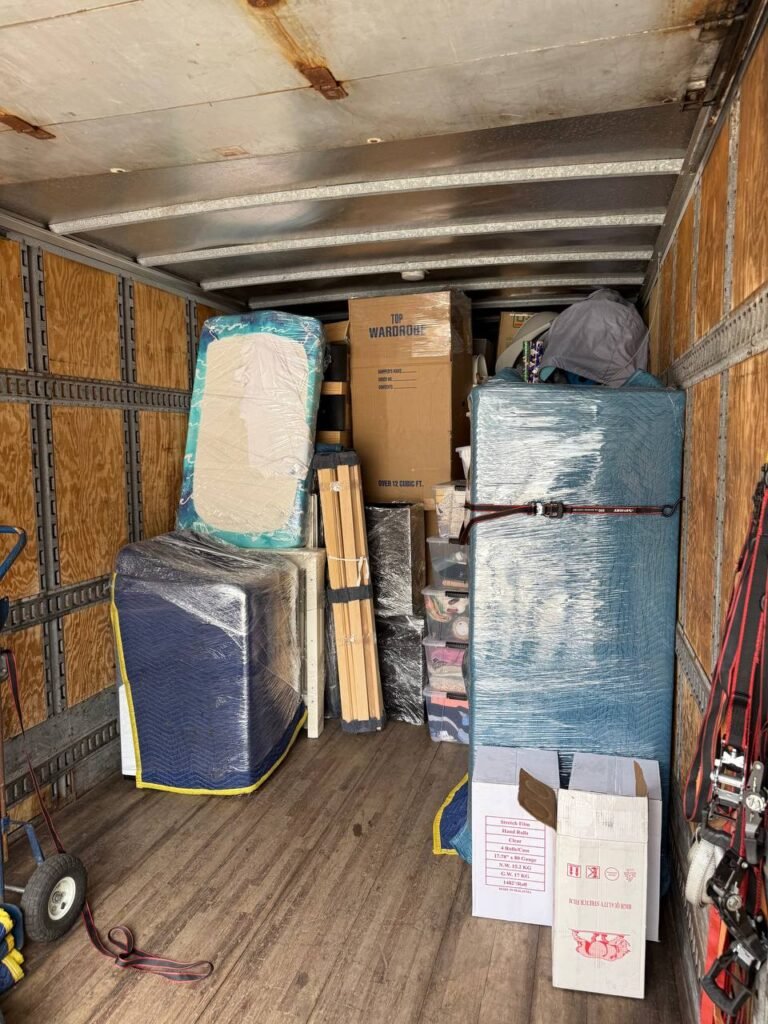
Use a proper ramp or lift gate and maintain control while the item enters the cargo area.
Inside the truck:
- Keep large pieces stable
- Use moving pads between furniture
- Avoid wood-on-wood rubbing
- Secure tall items
- Use straps where appropriate
- Keep fragile finishes away from sharp hardware
- Do not allow loose furniture to shift during transportation
A dresser that survived three flights of stairs can still be damaged by one hard stop if it is not secured inside the truck.
Do Not Use Bungee Cords as a Substitute for Proper Securement
Bungee cords can be useful for light jobs, but elastic cords are not the same as proper moving straps or ratchet straps for securing substantial furniture.
Heavy pieces need restraint that can handle their weight and movement.
Match the securement method to the item and the vehicle.
Unloading Requires the Same Care
It is easy to become less cautious once you reach the new home.
That is when damage often happens.
Before unloading furniture:
- Clear the destination route
- Protect the new floors
- Measure unfamiliar doorways
- Decide which room each item belongs in
- Check tight staircases
- Prepare sliders where needed
Do not drag furniture across the new floor because everyone is tired.
The floor does not care that it is 8 p.m.
Place Furniture Before Removing All Protection
Move the piece close to its final location before stripping off every blanket and pad.
That keeps the furniture protected while it is still passing walls and other items.
Once it is in the room, remove the wrapping and use clean furniture sliders if it needs fine positioning.
Avoid pushing a heavy dresser directly across fresh flooring to move it the last six inches.
Common Mistakes When Moving Heavy Furniture
Trying to Save Time by Skipping Measurements
A five-minute measurement can prevent half an hour of wrestling with furniture that physically cannot fit.
Leaving Drawers Full
It creates extra weight and lets the contents shift while the piece is tilted.
Dragging Furniture Directly Across the Floor
Even short distances can leave permanent scratches.
Carrying Everything Instead of Using Equipment
A dolly is not cheating.
It is what allows the weight to move predictably.
Using the Furniture’s Weakest Parts as Handles
Do not lift by:
- Drawer pulls
- Sofa arms
- Decorative trim
- Removable tops
- Glass
- Thin shelves
Grip structural parts of the furniture.
Skipping Padding Because the Move Is Local
Damage can happen five feet from the bedroom.
Distance has very little to do with whether a wall gets scraped.
Trying to Move Heavy Furniture Alone
Some pieces are simply not safe for one person.
A second person is not useful only for extra strength. They provide visibility, balance, communication, and control.
When Professional Furniture Movers Make More Sense
There is a point where DIY stops being economical.
Consider professional help when the move includes:
- Multiple heavy items
- Staircases
- Narrow hallways
- Expensive furniture
- Large sectionals
- Heavy solid wood pieces
- Tight apartment access
- Elevators
- Long carries
- Difficult parking
- Furniture that needs disassembly
- New or delicate flooring
Professional movers already have the equipment, padding, straps, and experience to deal with these situations repeatedly.
Comfy Moving offers labor-only movers if you already have a rental truck, trailer, POD, or other transportation and only need help with lifting, loading, unloading, or rearranging furniture.
For a complete household relocation, residential moving services can cover furniture disassembly, protection, loading, transportation, unloading, and reassembly as part of the move.
Heavy Furniture Moving Checklist
Before moving the first item:
- Measure the furniture
- Measure every doorway
- Check hallways and stair turns
- Clear the route
- Remove rugs and trip hazards
- Empty drawers and cabinets
- Disassemble removable components
- Label and bag hardware
- Protect floors
- Pad wall corners
- Protect narrow door frames
- Wrap the furniture
- Prepare sliders or dollies
- Put on secure footwear and gloves
- Agree on lifting commands
Before loading:
- Confirm the ramp is secure
- Keep the route clear
- Protect furniture from truck walls
- Separate finished surfaces
- Strap heavy furniture securely
- Prevent other items from falling onto it
At the new home:
- Inspect the route before unloading
- Protect new floors
- Measure unfamiliar spaces
- Place furniture in the correct room
- Reassemble only after the piece is safely positioned
- Use sliders for final placement
Frequently Asked Questions
What is the easiest way to move heavy furniture?
Reduce the weight first by emptying drawers and removing detachable parts. Use furniture sliders for short movements across a room and an appropriate dolly for longer carries. Protect floors and furniture before moving anything.
How do you move heavy furniture without scratching hardwood floors?
Clean the route first so grit cannot become trapped under sliders or equipment. Use sliders designed for hard floors, protective runners where appropriate, and never drag exposed furniture feet directly across the wood.
Can I move heavy furniture by myself?
Some smaller pieces can be repositioned alone with sliders or a dolly, but large furniture should not be treated as a solo job simply because you can lift one end. Stairs, tight turns, tall pieces, and unstable loads usually require additional help.
How do you move a heavy couch through a narrow doorway?
Measure both the sofa and doorway first. Remove legs or detachable sections when possible. Depending on the couch shape, rotating it vertically or entering one end first may create enough clearance. Protect the doorway and sofa before attempting the turn.
Are furniture sliders safe for hardwood floors?
They can be when they are specifically made for hard flooring and both the floor and slider surface are clean. Debris trapped underneath can still cause scratches.
Should you empty a dresser before moving it?
Yes, especially if it will be lifted or carried on stairs. Emptying drawers lowers the weight and prevents contents from shifting. Removable drawers can also be taken out when doing so makes the piece easier to handle.
What is the best equipment for moving heavy furniture?
The answer depends on the furniture and route. Furniture sliders, four-wheel furniture dollies, two-wheel utility dollies, lifting straps, moving blankets, and proper securement straps are among the most useful tools.
How do movers protect walls and doorways?
Protection may include moving blankets, corner guards, cardboard, floor runners, padding around furniture edges, careful measurement, controlled turns, and disassembly of pieces that would otherwise have very little clearance.
How do you move heavy furniture downstairs?
Use enough people, proper equipment, a completely clear staircase, and a coordinated plan. Protect the walls and stairs first. Large or particularly heavy items should not be taken down stairs alone.
Is it better to disassemble furniture before moving?
If the furniture is designed to be disassembled, usually yes. Smaller pieces are lighter and easier to maneuver through doors, stairs, and hallways. Check manufacturer instructions for ready-to-assemble furniture that may not tolerate repeated disassembly.
Heavy Furniture Should Not Leave Evidence Behind
A successful furniture move is almost invisible.
The sofa reaches the new living room, but the old hallway does not have fresh scars. The dresser comes down the stairs, but the railing stays intact. The dining table makes it through the doorway without taking the trim with it.
That result comes from preparation, not luck.
When you know how to move heavy furniture, the process becomes much more controlled: measure before lifting, remove what can safely come apart, protect the surfaces around you, use the right equipment, communicate clearly, and stop before a difficult situation becomes an unsafe one.
If the furniture is heavier, tighter, or more awkward than you want to handle yourself, Comfy Moving can take over the physical part of the job.
Our furniture moving and labor-only crews can help with in-home rearranging, loading, unloading, apartment moves, storage moves, and full household relocations throughout Orange County.
The goal is not simply to get the furniture through the doorway.
It is to get it through without leaving the doorway behind in pieces.
Services that match this moving topic